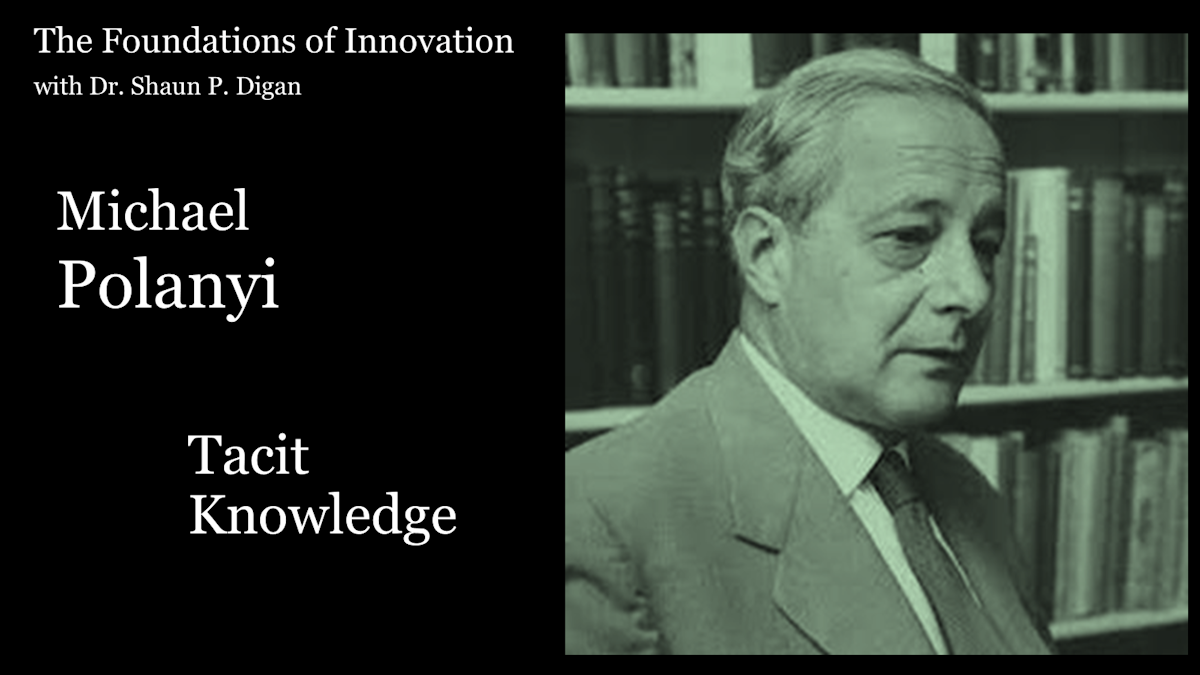
Week 16: Michael Polanyi and the Knowledge You Can Only Get by Standing Next to It
Every founder gets handed the same advice. Read the playbook. Study the frameworks. Watch the talks.
The best founders did all of that. It is not where their judgment came from.
Their judgment came from somewhere harder to point at. A few years inside a company that was getting it right. A boss who could look at a deal and know it was rotten before anyone could say why. A handful of operators on speed dial who had seen this exact mistake forty times. The frameworks were real. They were also the smallest part of what those founders learned.
Michael Polanyi spent the back half of his life explaining why.
Polanyi was a physical chemist first. Born in Budapest in 1891, he did serious work on reaction kinetics, adsorption, and X-ray crystallography, the kind of work that gets a person elected to the Royal Society. Then, in his fifties, he turned away from the bench and toward philosophy. The turn was not a hobby. He had become convinced that the reigning account of how knowledge works was wrong, and that the error was doing damage.
Part of what pushed him was a conversation. In 1935, in Moscow, the Soviet theorist Nikolai Bukharin told Polanyi that under socialism the distinction between pure and applied science would dissolve, because all research would be directed toward the needs of the current Five-Year Plan. The claim horrified him. Not for its politics alone. For its picture of knowledge. Bukharin assumed that discovery could be specified in advance, written down as instructions, and handed to scientists to execute. Polanyi had done discovery. He knew it did not work that way. He spent the next thirty years proving it.
Keep one question in view from here. If Polanyi was right, the founder who has no one to stand next to is not short on information. They are short on something no playbook contains.
Polanyi's Contribution
The whole argument fits in six words.
We can know more than we can tell.
That is the opening line of The Tacit Dimension, and it is the most important sentence Polanyi ever wrote. He meant it literally, and he meant it as a problem for everyone who believed that real knowledge is the kind you can fully state.
His first example is the one everyone has lived. You can recognize a person's face among thousands. You do this instantly, with near-perfect accuracy. Now describe that face precisely enough that a stranger could pick it out of a crowd. You cannot. The knowledge is complete and reliable and almost entirely unspeakable. You know the face. You cannot tell the face.
Polanyi called this tacit knowing, and he argued it was not a curiosity at the edge of human knowledge. It was the foundation under all of it. Every piece of explicit knowledge, every rule, every formula, every stated fact, rests on a body of tacit judgment that cannot itself be made explicit. The expert who can articulate ten rules is relying on a hundred more that they have never put into words and could not if asked.
He gave tacit knowing a precise shape. Consider a blind man with a probe. At first he feels the handle against his palm. After a while he stops noticing the handle and feels the tip meeting the world. His attention has traveled from the thing in his hand to the thing at the end of it. Polanyi called the first kind subsidiary awareness and the second focal awareness, and said all skilled knowing has this from-to structure. We attend from the particulars we have absorbed to the thing we are trying to understand. We are barely conscious of the particulars. They have become part of us.
He named that absorption indwelling. We dwell in our tools and skills the way we dwell in our own bodies. The pianist who thinks about her fingers stops playing music. This is why expertise is so hard to explain. The moment the expert turns to examine the particulars they have internalized, the performance falls apart, and they still cannot say what they were doing.
Then Polanyi drew the conclusion that matters most for founders. If a skill rests on knowledge that cannot be stated, it cannot be transmitted by stating it.
His sentence on this is worth quoting exactly:
An art which cannot be specified in detail cannot be transmitted by prescription, since no prescription for it exists. It can be passed on only by example from master to apprentice.
And the apprentice, watching, picks up more than the master can teach. In Polanyi's words, the apprentice "unconsciously picks up the rules of the art, including those which are not explicitly known to the master himself." The knowledge moves from one person to another without ever passing through language. It moves through proximity, through slowly coming to dwell in the same particulars the master dwells in. He called the mature form of this connoisseurship, the trained judgment of the wine taster or the diagnostician, which too "can be communicated only by example, not by precept."
Why It Mattered
The view Polanyi was arguing against was the dominant ideal of the twentieth century. Real knowledge was explicit, impersonal, and fully specifiable. Anything that could not be written down as a clear procedure was not knowledge. It was intuition, hunch, the soft stuff that rigor was supposed to replace.
Polanyi turned that ideal upside down. The explicit rests on the tacit, always, and a system that denies the tacit is not more rigorous. It is blind to its own foundation. The dream of fully specified knowledge, the dream Bukharin was selling, was incoherent. There is no such thing as knowledge with no tacit floor underneath it.
This reframed a long list of things people had treated as failures of rigor. The surgeon who senses something is wrong before the readout confirms it. The investor who reads a founder in five minutes. They are not being sloppy. They are exercising tacit knowing, the same faculty that lets you recognize a face. The judgment is real. The inability to state it is not a defect. It is the normal condition of expertise.
It also explained why apprenticeship survived everything that was supposed to replace it. Doctors still train by residency. Chefs still train in kitchens. Trades still run on apprenticeship after centuries of attempts to write the knowledge down. The core of the skill was never in the text. It passed person to person, by example, through indwelling. The apprenticeship was not a backward holdover. It was the channel built to carry tacit knowledge, and nothing cheaper has ever fully replaced it.
What It Left Open
Here the series has to be honest, because Polanyi does not hand us a door the way Simon and Kahneman did.
Polanyi proved that tacit knowledge exists. He described how it operates with more precision than anyone before or since. And then he told us how it transfers, and his answer is a problem.
It transfers by apprenticeship. Master to apprentice. By standing next to it.
That is not a neutral finding. It is a distribution mechanism, and a brutally unequal one. If the most important knowledge a founder needs is tacit, and tacit knowledge moves primarily through proximity to someone who already has it, then founder judgment is rationed by access. The founder who grew up near the work, who interned at the right company, who has the investor uncle and the operator friends, stands next to the masters as a matter of course. The judgment seeps in. The founder without that proximity gets the textbook, the explicit shadow of the knowledge, and none of what was never written down.
Polanyi did not flinch from this. He thought it was simply true, and he doubted the tacit could be scaffolded by anything other than human example. For him, the master was not a delivery system you could swap out. The master was the only channel there was.
So the series does not get to claim that Polanyi pointed toward the instrument. He did not. What he did was sharper and more uncomfortable. He named the exact mechanism by which founder capability stays concentrated where it already is.
The question he left open is the one the equity claim of this entire project runs into headfirst.
If the real knowledge is tacit, and tacit knowledge has moved primarily through apprenticeship, can anything other than a master transmit it?
Polanyi said no. He is also not the last word. In the decades after him, scholars from Nonaka to Lave and Wenger to Schön, several of whom the series reaches later, refused to treat the tacit as a sealed box. They asked whether it could be partially externalized, partially scaffolded, partially built by means other than standing next to a master. Their answer is a qualified yes with hard limits.
That changes the question. It is no longer whether a tool can pour the master's tacit knowledge into a founder. It cannot, because knowledge that can be poured was explicit to begin with. The real question is narrower. Can a tool help a founder build their own tacit judgment faster than they would alone. The bet underneath Startup.Ready. is "not all the way, but more than Polanyi thought."
What This Means for Founders Now
Start with the part Polanyi got exactly right, because it should change how a founder reads their own advice diet.
Most of what separates a seasoned founder from a first-timer is tacit. Knowing a market is too small before the TAM slide says so. Hearing a customer say "that's interesting" and knowing it means no. Sensing that a feature is a distraction while everyone on the team is excited about it. None of this lives in a framework. It lives in indwelling, built from exposure, and the first-time founder has not built it yet. This is not a character gap. It is the predictable condition of being early in a domain where judgment has to be earned through contact.
The advice ecosystem mostly ignores this, because the explicit layer is the only layer it can sell. It ships the rules and implies the rules are the knowledge. A founder who reads forty playbooks and mistakes them for the judgment of the people who wrote them has collected the descriptions of a face and still cannot recognize it.
So the founder without the network is not facing an information problem. They are facing an access problem, and no amount of reading closes it, because the thing they are missing was never in the reading. A tool that pretends to make the tacit fully explicit is selling the same thin residue in a new wrapper.
What helps is structure that does two things the master did, even if it cannot do the third.
Guided practice forces the learner to articulate. Standing next to someone better, you are constantly made to put your reasoning into words and watch it get corrected. Structured work can do a version of this. When a founder writes down the assumption they are treating as true, the evidence under it, and what breaks if it is wrong, some of what was sitting in the tacit fog gets pulled into the light.
There is a fair objection. The moment you write an assumption down, it is explicit by definition, so the worksheet has transferred no one's tacit knowledge. It has made the founder do rigorous homework. The objection is correct, and it is why the goal is not transfer. A founder cannot download a master's indwelling from a form. What articulation does is different. It surfaces the founder's own buried assumption so reality can rule on it, and the corrected judgment gets re-internalized as their own wordless sense of the thing. Articulate, test, absorb. Run the loop enough and the founder is building the tacit judgment Polanyi described, from their own exposure. The worksheet is the forcing function that turns exposure into judgment faster than exposure alone.
Observation and feedback also gave the apprentice reps, faster than unaided experience would, because proximity to expertise compresses exposure. You watch forty deals go bad in two years instead of meeting one every two years on your own.
Here too there is an honest limit. A logged decision is not a master watching over your shoulder, correcting you in the moment while the counterparty is still in the room. A tool cannot do that. The market does the correcting, and it does it late. Structured work is not the dialogical core of apprenticeship, and claiming otherwise would be a lie the reader would catch.
What it changes is whether that late feedback is usable when it lands. Solo trial and error teaches slowly because the founder rarely wrote down what they predicted, so when the result arrives they cannot tell which assumption was wrong. The lesson dissolves into a vague sense that things did not work out. Articulating the assumption first turns a market outcome into an attributable correction. The decision was logged. The prediction was specific. When reality disagrees, the founder knows where. That is the difference between losing and learning while you lose.
What it does not do is replace the master. A structured instrument is not a great mentor, and it pours no one's judgment into anyone. It is a scaffold for the founder who has no one to stand next to. Two of the things apprenticeship supplies, the discipline of articulation and the ability to learn systematically from experience, can be partially scaffolded in software. The software does not supply the rep. Reality supplies the rep. The software makes it count. The rest of what a master gives cannot be reproduced, and this project does not pretend it can.
Polanyi drew the line between what can be told and what can only be shown. Most of the startup world pretends the line is not there and sells the tellable part as the whole. The deepest founder judgment is tacit and will stay that way. The access problem Polanyi described is real, and it is not one a founder should be asked to accept.
If you have the master, stand next to them, and let the structure sharpen what you carry away. If you do not, the playbook is not your apprenticeship. Structured work, done honestly and tracked over time, is the closest thing to one you can build for yourself. Either way, you are working on the layer that actually decides things.
Theoretical Takeaway
Polanyi established that the founder-level reasoning this series cares about is largely tacit. We know more than we can tell, and the most consequential expert judgment cannot be written down as instructions. The complication is the transmission mechanism. Tacit knowledge moves by example, through proximity, and that rations founder judgment by access, the inequality the equity claim of this project exists to attack. He doubted it could be scaffolded for anyone who had not yet developed it. The scholars who followed found a qualified yes with hard limits. No tool transfers a master's tacit knowledge, because anything transferable was already explicit. A tool can do something narrower. It can force articulation and make late feedback attributable, and those moves help a founder build their own tacit judgment faster than working alone. That development question is exactly the one the instrument is built to address.
Next week: Karl Popper and falsification. The philosophical foundation underneath the Lean Startup, and why "test your assumptions" is a deeper instruction than the people repeating it usually realize.
Originally Published in the Startup.Ready. Foundations of Innovation Series at https://www.startupreadinessscore.com/essays/polanyi
Original Publication Date: June 22, 2026
Last Updated: June 22, 2026
By Dr. Shaun P. Digan, MBA, PhD
Sources
Personal Knowledge: Towards a Post-Critical Philosophy, Michael Polanyi, University of Chicago Press (1958)
The Tacit Dimension, Michael Polanyi, University of Chicago Press (1966)
Science, Faith and Society, Michael Polanyi, University of Chicago Press (1946)
About the Author
Dr. Shaun P. Digan is the founder of Startup.Ready and the creator of the Startup Readiness Framework, a research-based system for evaluating and strengthening the foundations of early-stage startups. He holds a PhD in Entrepreneurship from the University of Louisville and has spent 15 years teaching, advising, and consulting with founders. In this series, The Foundations of Innovation, he writes on the ideas that built the startup world and the one idea still missing from all of them.